


Work in Progress 5

Updated: Apr 29
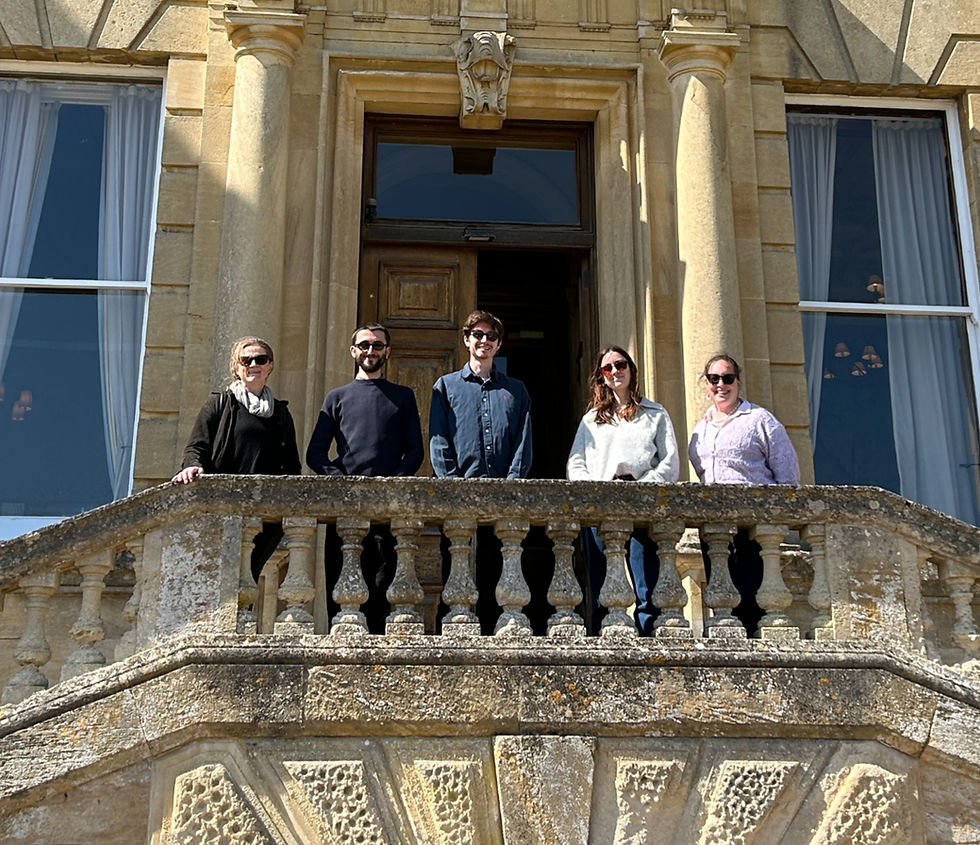
Below the team shares what we’ve been up to over the past half a year in addition to our routine activities of dealing with enquiries and assisting visitors. We welcomed Ted to the team in October. You can learn more about his work here.
Rebecca Somerset, Province Archivist:

The most exciting task of the past few months has been organising the launch of the collaborative volume Second World War through Jesuit Archives: The Case of Europe (1939-1945). I am both pleased and greatly relieved that the book has now been published. The launch itself was a wonderful evening, and I was delighted to be joined by several of the project’s collaborators: Damien Burke (Irish Jesuit Archives), Dr Barbara Baudry (EOF), Dr Jo Lutyen (KADOC, for the former Belgian and Dutch archives) in addition to Dr Camilla Russell (IHSI). The event also featured an excellent overview presentation by Brian Mac Cuarta SJ.
Earlier, in November, I took part in a joint presentation with Dr Jan Graffius, curator at Stonyhurst College, for Jesuit parishes entitled “Skeletons in the Cupboard: Jesuit Archives.” This session offered an overview of the kinds of archival and heritage materials that may be found in parishes, along with practical guidance on their care. I was also very pleased to finally hold a reminiscence session with the Jesuit community in Boscombe at the end of March, following two earlier postponements.
At the start of 2026, we acquired the archives of several former Jesuit schools. This involved their collection, packing, and transport, and has resulted in boxes now filling much of the British Jesuit Archives as they await appraisal, cataloguing, and repackaging. I also visited Donhead School to assess their holdings and provide advice on the care of their archival materials.
Alongside this, I have been steadily cataloguing our reference library, which contains books by or about Jesuits of the Province as well as books on its history and thus also more generally British Catholic history. Over 100 books have now been added here and are available to consult, with more continuing to be incorporated as time permits. The reference library is open by appointment for onsite consultation only.
Mary Allen, Deputy Archivist:
Over the last six months, I have continued to make good progress on the Archives of the Cause of the English and Welsh Martyrs. I am very pleased to report that the listing of this collection has now been completed. This means I can now focus on arranging and repackaging the material, and preparing the catalogue in a format ready for import into our cataloguing software.
On the topic of cataloguing software, the network of archives and libraries that we are part of, NALCC, voted last year to transfer our catalogues from Calm to Atom. Since the last work-in-progress blog, we have gained access to Atom and begun the substantial task of migrating our data. So far, we have imported over a thousand authority files (records that standardise names of people, organisations, or subjects for consistent cataloguing) and more than 800 accession records (records documenting when and how items enter a collection).
This has been a time-consuming process involving a great deal of data manipulation and trial and error, but we are beginning to get to grips with it and are now preparing to import our 17,000 catalogue descriptions. We anticipate this will take several weeks, if not months, but we are also using it as an opportunity to tidy up our catalogue and bring it up to the standard we would like. It has been an interesting and challenging process so far, particularly as we are not IT professionals, and I am not sure how we would have managed it without the help of ChatGPT!
Part of the work of the Archives team is assisting with the papers of Jesuits who have died. Last month, I visited two Jesuit residences, Corpus Christi in Boscombe and Manresa House in Birmingham, to sort through and pack up the papers of three Jesuits, which will in time be transferred to the Archives. Although this can be a sad process, I always appreciate the opportunity to visit other Jesuit communities and to have interesting conversations with members over lunch.
After Easter, Jamie and I attended the biannual Province gathering for Jesuits
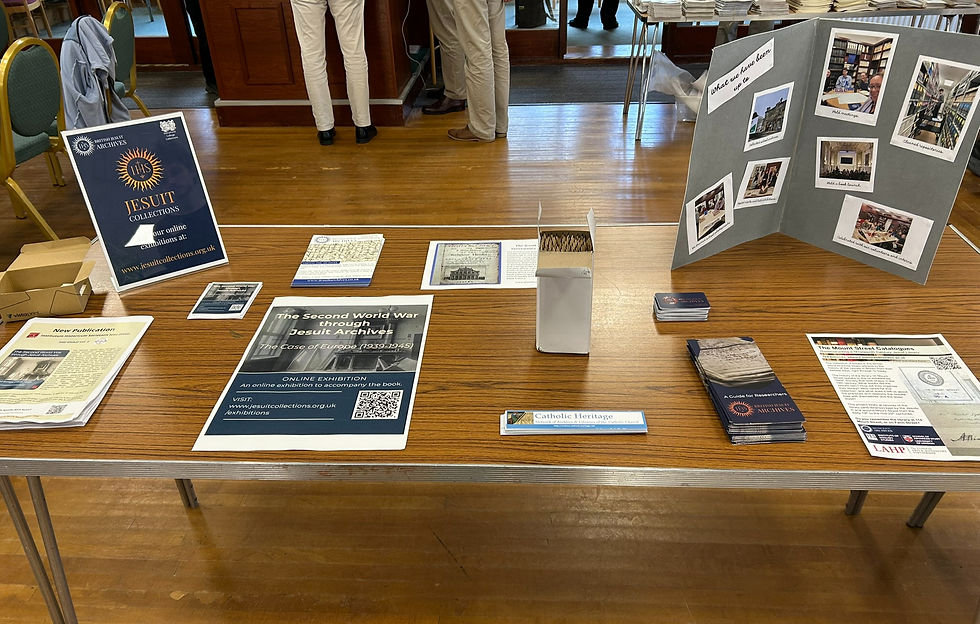
and lay staff. Over three and a half days, we attended talks by Jesuits from our own and other provinces as well as lay collaborators, met in small groups organised by sector to discuss and reflect on what we'd heard, and contributed to the Province works’ showcase, where we put together a stand with information about our latest projects, as well as official British Jesuit Archives pencils and stickers (which proved to be popular). There was also some light relief in the form of a bingo-style icebreaker on the first night and a pub quiz. On the final night, we celebrated those members of the Society marking major anniversaries. The whole event was a valuable opportunity to meet new people, learn more about the range of work across the Province, and catch up with familiar faces.
Lucy Vinten, Assistant Archivist and Rare Book Cataloguer:
Cataloguing the large seventeenth century books has been my main focus for the last few months. I haven’t quite finished – I have two books left to go! The cataloguing process includes making accurate measurements of the books, which is harder than it may seem as the books are anything but regularly shaped and very few have any right angles. The next step will be to use the measurements to order bespoke boxes to keep the books in. Hopefully (if my measurements are accurate!) these will fit perfectly so the books don’t rattle inside but are protected from environmental and mechanical damage. The boxes help with the long term preservation of the books and will greatly increase their lifespan. It is a real relief to be so near the end of this part of the cataloguing and boxing project. Once done, I will start on the eighteenth century large books.
Recently, I have spent the best part of two weeks reorganising the nineteenth century books and making them findable. A few years ago we had to move all the books (and all the archives) out while the storage spaces were refurbished. When everything returned, the books were reshelved at speed, and not in much order, so they have been difficult to manage. Gradually we have been creating systems to find the books, with all the sixteenth, seventeenth and twentieth century books, as well as most of the eighteenth century books stored in order and locatable via our finding aids. It was finally the turn of the nineteenth century books. Taking advantage of a couple of weeks with few visitors booked in I took the opportunity to spread the books out across the Reading Room, and utilised the still-empty Corridor Cupboards (part of our latest refurbishment project) to help organise and categorise the books.

The nineteenth century books had previously been catalogued, using the revised Library of Congress Cataloguing system that is also used for our Reference Library. They may get re-catalogued in the future, but for now they are all shelved in a findable order, and temporary shelf labels help us locate each run of books.
I continue to be the ‘Designated Driver’ of the Archives Team. In November I made another trip to St Beuno’s to bring into our care some of the older books which were surplus to their requirements. We have kept these together as a discrete collection along with the other St Beuno’s books. There is a basic list of these, but creating a fuller catalogue of them is a task on my horizon. In January I had to collect archival material from three former schools. For two of these, Mount St Mary’s and Barlborough Hall, both in Derbyshire, there was so much material that Rebecca and I hired a Luton van to bring it all back to Mount Street.

It was three days of manual labour, packing, carrying and loading nearly a ton of material. The sheer range of tasks is one of the things I love about working here in the Jesuit archives – one day I’ll be wresting with deciphering Latin written in a difficult seventeenth hand and the next I’ll be doing a bit of lorry driving. It’s hard to get bored with such varied work!
Jamie Hennessy Jackson, Cataloguing Archivist:
Since our last update, I have finished cataloguing the papers of old Heythrop College, the Jesuit Collegium Maximum which existed from 1926 until the move to London in 1970. Given that this year is thus the centenary of its establishment, and that the archives are now fully catalogued and searchable, we decided to tie in a work expedition with a visit to Heythrop. Our first stop was to Jamie Briggs, a storage and transport company based at a striking former US Cold War airfield in Oxfordshire, dotted with countless reinforced concrete hangers designed to withstand direct impacts from 1000-pound bombs. Their new storage area has been custom-built into one of these hangers, which already have excellent, naturally stable temperature and humidity ideal for storing archival materials. We were given a presentation on their capabilities and then a tour of this state-of-the-art facility, which is already in use by Oxford Colleges and national museums. As the holdings of our archive rapidly expands, the need for offsite storage to accommodate our needs has grown increasingly urgent.
We then headed on to nearby Heythrop Park, now a hotel, spa, and golf course set on a stunning 440-acre estate. We were given a tour by a knowledgeable team member, and I had printed out photos of the Heythrop house and grounds as they were in the 1920s, so we were able to directly compare how things had changed over the last 100 years (and be amazed by how much had been preserved!). We were particularly touched to visit the cemetery there, still well-maintained by the hotel staff, and see the names of prominent Jesuits including Charles Newdigate, Leslie Walker, and James Sharkey. After the tour, the hotel treated us to a lovely afternoon tea (pictured below), which was so extensive that we had to take some home with us.
Aside from this, I have also catalogued the archives of St John’s Beaumont, one of two Jesuit schools which closed last year and whose collections have since been transferred to us. Having catalogued the archives of Beaumont College as my first large project working here, it was a satisfying conclusion of sorts to catalogue its feeder school too. Highlights included an enormously rich and varied photograph collection, and a large collection of reliquaries featuring relics from all major Jesuit saints and many others.
However, over the last couple of months I have been working closely with Mary both at the Province Gathering and on the AtoM migration project, which has involved me rapidly becoming intimately familiar with Excel formulas, power queries, and other tools! This means that despite being a Cataloguing Archivist, cataloguing has very much taken the backseat as of late. Once the AtoM migration is complete, I will return to form and continue with the archives of “New Heythrop”, dating from after the move to London.

Ted Simonds, LAHP/AHRC funded PhD Student:
I am now halfway through the first year of my work on the library of the British Jesuit Archives. My main task has been to familiarise myself with the holdings of the library and archive on Mount Street, to read up on the history of Catholics, Jesuits, and libraries in the nineteenth century (and beyond). And more specifically, I have been learning about the activities of the Jesuits in London since William Strickland started living on Poland Street in 1803.
I’ve been having tremendous fun. One of my first jobs was to read through Letters and Notices looking for mention of the library (or libraries!) on Mount Street. On the other end of a book’s life, I became fascinated by who was printing for the Jesuits in Britain – and was surprised and charmed by the story of Br James Stanley SJ, who through talent and hard work transformed the world of Jesuit printing in Britain at the end of the nineteenth century.
My core task considers the two Mount Street catalogues themselves. The earlier catalogue (while incomplete) records 1,764 titles belonging to the Jesuits in London in the mid-1840s, which grows to 5,939 titles in the 1890s catalogue. How these catalogues can be thought of as part of a wider Jesuit culture of library/book use in the nineteenth century is a question my project aims to investigate. Comparing these catalogues to those of the Campbell Library at Beaumont College, and to the collections of books at Stonyhurst, Heythrop, Campion Hall, and St Beuno’s will reveal more about the informational context of these catalogues. Knowing who the Jesuits behind the care of these libraries were in the nineteenth century will shed new light on networks of professional and devotional practice across the nineteenth century Province.
More work awaits!
Archive Volunteers:
We are grateful for the invaluable contributions our incredible volunteers bring to our work. Over the past six months, Boqi, Cyril, Eleanor, Hannah-Grace, Neron, Patrick and Rebecca have assisted us in cataloguing 18th century books, digitisation projects and listing photographs. Their dedication has contributed to our efforts, and we extend our thanks for their hard work and commitment.
***
We hope you enjoyed discovering a bit about the work we are currently engaged with. Please contact us if you would like to know more about any of these areas of work.


Comments